DevOps Engineering
For us, DevOps is a way to move fast and stay whole on the curves. Infrastructure that lets us experiment, ship changes, roll them back without panic, and see what the system is doing right now. We follow the GitHub approach: Infrastructure as Code, where everything is described in code and the state of the system lives in Git. This is your guarantee that your digital assets stay safe, portable, and reproducible. When infrastructure is described in code, you can roll back to any point quickly, rebuild the environment from scratch, and trust that it will behave exactly as it did yesterday.

Business value
Reproducibility means the environment can be stood up again and it will be the same. Private repositories store the code and the infrastructure configuration — your backup and your change history. Portability of digital assets means you are free from any single provider or server. Fast rollbacks save you from costly mistakes: if something goes sideways, you return to a working version within minutes. This matters especially for the business side: your digital assets stay safe, they move between environments, and when trouble arrives you have the ability to roll back quickly. Infrastructure becomes an asset.
We love speed. And speed without production hygiene ends with you afraid to touch your own system.
MLOps and inference engineering
MLOps is the natural continuation of DevOps for machine learning. Together with inference engineers we look for solutions for instances where GPUs and specialised environments are required. This is especially relevant given how quickly new models appear and how important it is to test them quickly. Good infrastructure drops the price of an experiment significantly. This is especially true on the ML side: if you need to deploy models yourself, the faster you can apply them, the better. Tomorrow a new model may appear that solves your task better — and you need to be ready to test it quickly. Without the right infrastructure every experiment costs a lot. With the right one, you can try dozens of variants in a day.
Working with secrets and security
Secret management is a mandatory part of modern DevOps. We use Vault and cloud solutions for secret management, because keeping passwords and keys in code or configs is a risk. Secrets must be isolated, versioned, and available only to those who actually need them. Security is a habit: secrets in the right vaults, access policies, minimal permissions, clear boundaries. Every deployment is checked for security, every access is logged, every error is analysed.
Cloud and bare metal
We work in the cloud and on bare metal — because the choice depends on the task. Clouds give flexibility and scalability; bare metal gives control and predictability. Sometimes a combination is needed: your own servers for critical workloads, cloud for experiments. A particularly interesting task is connecting your own machines to Kubernetes. If you have your own hardware with GPUs and prefer to keep it out of the cloud, you can connect it to a single Kubernetes cluster. This delivers centralised management while using your own resources. Useful for anyone working with ML models who wants to control the infrastructure while keeping cloud GPU bills in check.
Standards and playbooks
We pay separate attention to writing tools, standards, and playbooks for programmers. We describe the current mechanisms, CI/CD, testing, and deployment processes. Because DevOps is about infrastructure and the comfort of every team's work. There are standards: how to deploy, how deployments are forbidden, which checks are mandatory, how to roll back. There are playbooks: how to work with secrets, how to set up monitoring, how to debug issues. All of it makes the work predictable and clear for everyone involved. For us DevOps is about discipline and about comfort. Discipline means everything is described, checked, and documented. Comfort means programmers can work without thinking about infrastructure, and operations never turns into a nightmare.
How this shows up in our projects
Pipelines that require no shamanism. Deployments that can be stopped. Infrastructure that does not depend on "that one person who remembers". And a habit of measuring: speed, stability, cost of mistakes, resource consumption. One of our core metrics is resource consumption. How reasonable it is, how it can be reshuffled, where it can be optimised. Because good infrastructure works efficiently. If you need to bring a system into a state where it can be evolved calmly — we know how to put together a plan of work and take the first steps so that you can move on your own afterwards.
Status
The competence is active and continuously evolving — because our projects demand speed, stability, and clarity all at once. Field infrastructure on microcomputers: sensors, local processing, communications and observability - when reality needs to be measured.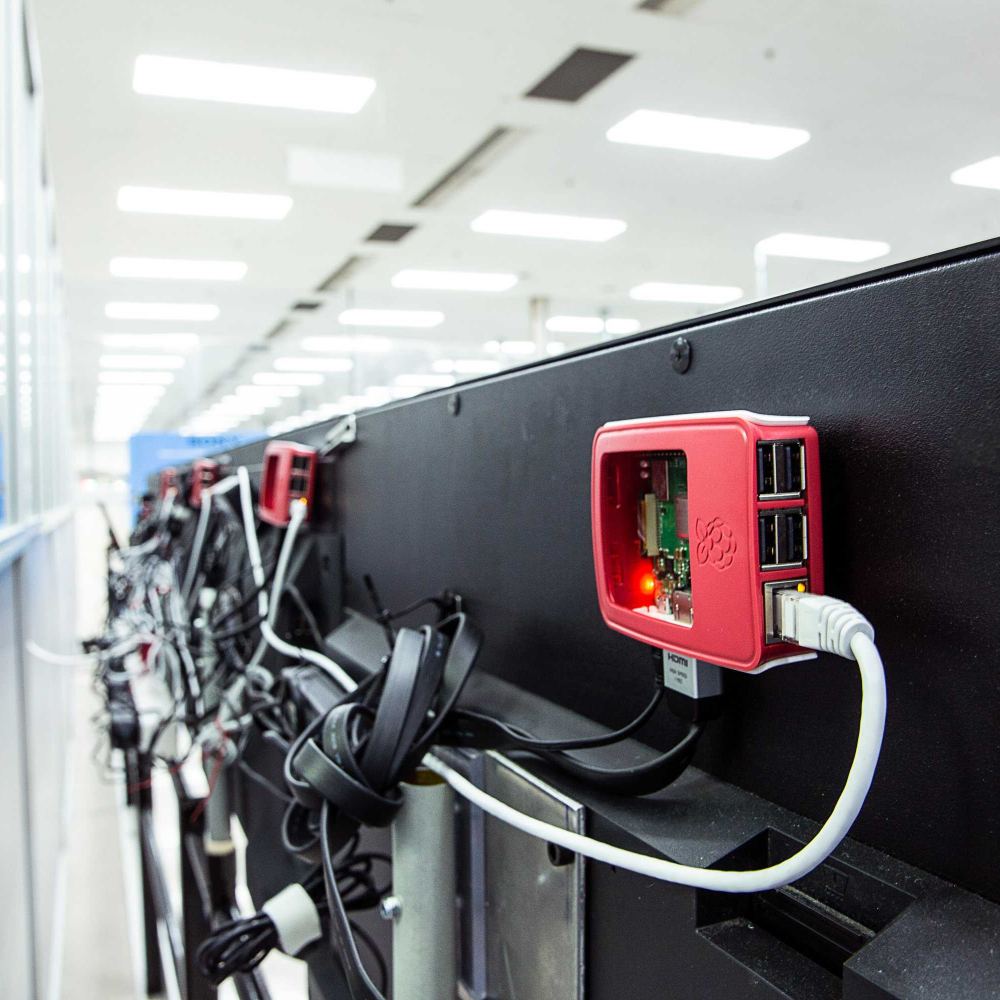
Microcomputers